Ebook 1984, by George Orwell
Reading 1984, By George Orwell is a very valuable passion and doing that could be gone through at any time. It implies that reading a book will certainly not restrict your task, will not compel the time to invest over, and won't spend much money. It is a quite inexpensive as well as reachable point to purchase 1984, By George Orwell However, with that extremely economical thing, you can get something new, 1984, By George Orwell something that you never do and get in your life.
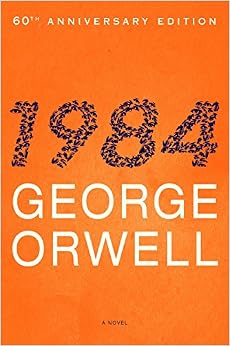
1984, by George Orwell

Ebook 1984, by George Orwell
The amount of times we should claim that publication as well as reading is crucial for individuals living? Guide visibility is not just for the ordered or perhaps used loaded of papers. This is a very priceless thing that can alter people living to be better. Even you are always asked to check out a publication and read again, you will feel so challenging when informed to do it. Yeah, many individuals also feel that. Feel that it will be so monotonous to check out books, from primary to grownups.
Checking out comes to be on part of the life that should be done by everyone. Checking out ought to be believed from earlier to be behavior and leisure activity. Also there are many people with variant hobbies; it doesn't indicate that you could not enjoy checking out as other activity. Reviewing 1984, By George Orwell is just one of the methods for you to improve your high quality of the life. It is such assumed in the many sources.
You may not feel that this book will be as crucial as you believe right now, however are you sure? Discover more regarding 1984, By George Orwell and you could truly locate the benefits of reading this book. The supplied soft data publication of this title will certainly offer the remarkable scenario. Even reading is just hobby; you can start to be success b this publication. Assume extra in judging guides. You could not judge that it is very important or not now. Read this book in soft file and also get the methods of you to wait.
When you have reviewed it more web pages, you will certainly know a growing number of once again. Furthermore when you have checked out all ended up. That's your time to constantly remember and also do exactly what the lesson and experience of this publication used to you. By this problem, you need to understand that every publication ahs various means to provide the impression to any type of visitors. Yet they will certainly be and have to be. This is exactly what the DDD constantly offers you lesson concerning it.
About the Author
George Orwell (pseudonym for Eric Blair [1903-50]) was born in Bengal and educated at Eton; after service with the Indian Imperial Police in Burma, he returned to Europe to earn his living penning novels and essays. He was essentially a political writer who focused his attention on his own times, a man of intense feelings and intense hates. An opponent of totalitarianism, he served in the Loyalist forces in the Spanish Civil War. Besides his classic Animal Farm, his works include a novel based on his experiences as a colonial policeman, Burmese Days, two firsthand studies of poverty, Down and Out in Paris and London and The Road to Wigan Pier, an account of his experiences in the Spanish Civil War, Homage to Catalonia; and the extraordinary novel of political prophecy whose title became part of our language, 1984.
Read more
Excerpt. © Reprinted by permission. All rights reserved.
ONEIt was a bright cold day in April, and the clocks were striking thirteen. Winston Smith, his chin nuzzled into his breast in an effort to escape the vile wind, slipped quickly through the glass doors of Victory Mansions, though not quickly enough to prevent a swirl of gritty dust from entering along with him.The hallway smelt of boiled cabbage and old rag mats. At one end of it a colored poster, too large for indoor display, had been tacked to the wall. It depicted simply an enormous face, more than a meter wide: the face of a man of about forty-five, with a heavy black mustache and ruggedly handsome features. Winston made for the stairs. It was no use trying the lift. Even at the best of times it was seldom working, and at present the electric current was cut off during daylight hours. It was part of the economy drive in preparation for Hate Week. The flat was seven flights up, and Winston, who was thirty-nine, and had a varicose ulcer above his right ankle, went slowly, resting several times on the way. On each landing, opposite the lift shaft, the poster with the enormous face gazed from the wall. It was one of those pictures which are so contrived that the eyes follow you about when you move. BIG BROTHER IS WATCHING YOU, the caption beneath it ran.Inside the flat a fruity voice was reading out a list of figures which had something to do with the production of pig iron. The voice came from an oblong metal plaque like a dulled mirror which formed part of the surface of the right-hand wall. Winston turned a switch and the voice sank somewhat, though the words were still distinguishable. The instrument (the telescreen, it was called) could be dimmed, but there was no way of shutting it off completely. He moved over to the window: a smallish, frail figure, the meagerness of his body merely emphasized by the blue overalls which were the uni- form of the Party. His hair was very fair, his face naturally sanguine, his skin roughened by coarse soap and blunt razor blades and the cold of the winter that had just ended.Outside, even through the shut window pane, the world looked cold. Down in the street little eddies of wind were whirling dust and torn paper into spirals, and though the sun was shining and the sky a harsh blue, there seemed to be no color in anything except the posters that were plastered every- where. The black-mustachio’d face gazed down from every commanding corner. There was one on the house front immediately opposite. BIG BROTHER IS WATCHING YOU, the caption said, while the dark eyes looked deep into Winston’s own. Down at street level another poster, torn at one corner, flapped fitfully in the wind, alternately covering and uncovering the single word INGSOC. In the far distance a helicopter skimmed down between the roofs, hovered for an instant like a blue-bottle, and darted away again with a curving flight. It was the Police Patrol, snooping into people’s windows. The patrols did not matter, however. Only the Thought Police mattered.Behind Winston’s back the voice from the telescreen was still babbling away about pig iron and the overfulfillment of the Ninth Three-Year Plan. The telescreen received and transmitted simultaneously. Any sound that Winston made, above the level of a very low whisper, would be picked up by it; moreover, so long as he remained within the field of vision which the metal plaque commanded, he could be seen as well as heard. There was of course no way of knowing whether you were being watched at any given moment. How often, or on what system, the Thought Police plugged in on any individual wire was guesswork. It was even conceivable that they watched everybody all the time. But at any rate they could plug in your wire whenever they wanted to. You had to live— did live, from habit that became instinct—in the assumption that every sound you made was overheard, and, except in darkness, every movement scrutinized.Winston kept his back turned to the telescreen. It was safer; though, as he well knew, even a back can be revealing. A kilometer away the Ministry of Truth, his place of work, towered vast and white above the grimy landscape. This, he thought with a sort of vague distaste—this was London, chief city of Airstrip One, itself the third most populous of the provinces of Oceania. He tried to squeeze out some childhood memory that should tell him whether London had always been quite like this. Were there always these vistas of rotting nineteenth- century houses, their sides shored up with balks of timber, their windows patched with cardboard and their roofs with corrugated iron, their crazy garden walls sagging in all directions? And the bombed sites where the plaster dust swirled in the air and the willow herb straggled over the heaps of rubble; and the places where the bombs had cleared a larger path and there had sprung up sordid colonies of wooden dwellings like chicken houses? But it was no use, he could not remember: nothing remained of his childhood except a series of bright-lit tableaux, occurring against no background and mostly unintelligible.The Ministry of Truth—Minitrue, in Newspeak*—was startlingly different from any other object in sight. It was an enormous pyramidal structure of glittering white concrete, soaring up, terrace after terrace, three hundred meters into the air. From where Winston stood it was just possible to read, picked out on its white face in elegant lettering, the three slogans of the Party:WAR IS PEACE FREEDOM IS SLAVERYIGNORANCE IS STRENGTH.The Ministry of Truth contained, it was said, three thousand rooms above ground level, and corresponding ramifications below. Scattered about London there were just three other buildings of similar appearance and size. So completely did they dwarf the surrounding architecture that from the roof of Victory Mansions you could see all four of them simultaneously. They were the homes of the four Ministries between which the entire apparatus of government was divided: the Ministry of Truth, which concerned itself with news, entertainment, education, and the fine arts; the Ministry of Peace, which concerned itself with war; the Ministry of Love, which maintained law and order; and the Ministry of Plenty, which was responsible for economic affairs. Their names, in Newspeak: Minitrue, Minipax, Miniluv, and Miniplenty.The Ministry of Love was the really frightening one. There were no windows in it at all. Winston had never been inside the Ministry of Love, nor within half a kilometer of it. It was a place impossible to enter except on official business, and then only by penetrating through a maze of barbed-wire entanglements, steel doors, and hidden machine-gun nests. Even the streets leading up to its outer barriers were roamed by gorilla-faced guards in black uniforms, armed with jointed truncheons.Winston turned round abruptly. He had set his features into the expression of quiet optimism which it was advisable to wear when facing the telescreen. He crossed the room into the tiny kitchen. By leaving the Ministry at this time of day he had sacrificed his lunch in the canteen, and he was aware that there was no food in the kitchen except a hunk of dark-colored bread which had got to be saved for tomorrow’s breakfast. He took down from the shelf a bottle of colorless liquid with a plain white label marked VICTORY GIN. It gave off a sickly, oily smell, as of Chinese rice-spirit. Winston poured out nearly a teacupful, nerved himself for a shock, and gulped it down like a dose of medicine.Instantly his face turned scarlet and the water ran out of his eyes. The stuff was like nitric acid, and moreover, in swallow- ing it one had the sensation of being hit on the back of the head with a rubber club. The next moment, however, the burning in his belly died down and the world began to look more cheerful. He took a cigarette from a crumpled packet marked VICTORY CIGARETTES and incautiously held it upright, where- upon the tobacco fell out onto the floor. With the next he was more successful. He went back to the living room and sat down at a small table that stood to the left of the telescreen. From the table drawer he took out a penholder, a bottle of ink, and a thick, quarto-sized blank book with a red back and a marbled cover.For some reason the telescreen in the living room was in an unusual position. Instead of being placed, as was normal, in the end wall, where it could command the whole room, it was in the longer wall, opposite the window. To one side of it there was a shallow alcove in which Winston was now sitting and which, when the flats were built, had probably been intended to hold bookshelves. By sitting in the alcove, and keeping well back, Winston was able to remain outside the range of the telescreen, so far as sight went. He could be heard, of course, but so long as he stayed in his present position he could not be seen. It was partly the unusual geography of the room that had suggested to him the thing that he was now about to do.But it had also been suggested by the book that he had just taken out of the drawer. It was a peculiarly beautiful book. Its smooth creamy paper, a little yellowed by age, was of a kind that had not been manufactured for at least forty years past. He could guess, however, that the book was much older than that. He had seen it lying in the window of a frowsy little junk shop in a slummy quarter of the town (just what quarter he did not now remember) and had been stricken immediately by an overwhelming desire to possess it. Party members were sup- posed not to go into ordinary shops (“dealing on the free mar- ket,” it was called), but the rule was not strictly kept, because there were various things such as shoelaces and razor blades which it was impossible to get hold of in any other way. He had given a quick glance up and down the street and then had slipped inside and bought the book for two dollars fifty. At the time he was not conscious of wanting it for any particular pur- pose. He had carried it guiltily home in his brief case. Even with nothing written in it, it was a compromising possession. The thing that he was about to do was to open a diary. This was not illegal (nothing was illegal, since there were no longer any laws), but if detected it was reasonably certain that it would be punished by death, or at least by twenty-five years in a forced-labor camp. Winston fitted a nib into the penholder and sucked it to get the grease off. The pen was an archaic in- strument, seldom used even for signatures, and he had pro- cured one, furtively and with some difficulty, simply because of a feeling that the beautiful creamy paper deserved to be written on with a real nib instead of being scratched with an ink pencil. Actually he was not used to writing by hand. Apart from very short notes, it was usual to dictate everything into the speakwrite, which was of course impossible for his present purpose. He dipped the pen into the ink and then faltered for just a second. A tremor had gone through his bowels. To mark the paper was the decisive act. In small clumsy letters he wrote: April 4th, 1984.He sat back. A sense of complete helplessness had de- scended upon him. To begin with, he did not know with any certainty that this was 1984. It must be round about that date, since he was fairly sure that his age was thirty-nine, and he believed that he had been born in 1944 or 1945; but it was never possible nowadays to pin down any date within a year or two.For whom, it suddenly occurred to him to wonder, was he writing this diary? For the future, for the unborn. His mind hovered for a moment round the doubtful date on the page, and then fetched up with a bump against the Newspeak word doublethink. For the first time the magnitude of what he had undertaken came home to him. How could you communicate with the future? It was of its nature impossible. Either the future would resemble the present, in which case it would not listen to him, or it would be different from it, and his predicament would be meaningless.For some time he sat gazing stupidly at the paper. The telescreen had changed over to strident military music. It was curious that he seemed not merely to have lost the power of expressing himself, but even to have forgotten what it was that he had originally intended to say. For weeks past he had been making ready for this moment, and it had never crossed his mind that anything would be needed except courage. The actual writing would be easy. All he had to do was to transfer to paper the interminable restless monologue that had been run- ning inside his head, literally for years. At this moment, how- ever, even the monologue had dried up. Moreover, his varicose ulcer had begun itching unbearably. He dared not scratch it, because if he did so it always became inflamed. The seconds were ticking by. He was conscious of nothing except the blankness of the page in front of him, the itching of the skin above his ankle, the blaring of the music, and a slight booziness caused by the gin.Suddenly he began writing in sheer panic, only imperfectly aware of what he was setting down. His small but childish handwriting straggled up and down the page, shedding first its capital letters and finally even its full stops:April 4th, 1984. Last night to the flicks. All war films. One very good one of a ship full of refugees being bombed somewhere in the Mediterranean. Audience much amused by shots of a great huge fat man trying to swim away with a helicopter after him. first you saw him wallowing along in the water like a porpoise, then you saw him through the helicopters gunsights, then he was full of holes and the sea round him turned pink and he sank as suddenly as though the holes had let in the water. audience shouting with laughter when he sank. then you saw a lifeboat full of children with a helicop- ter hovering over it. there was a middleaged woman might have been a jewess sitting up in the bow with a little boy about three years old in her arms. little boy screaming with fright and hiding his head between her breasts as if he was trying to burrow right into her and the woman putting her arms around him and comfort- ing him although she was blue with fright herself. all the time covering him up as much as possible as if she thought her arms could keep the bullets off him. then the helicopter planted a 20 kilo bomb in among them terrific flash and the boat went all to matchwood. then there was a wonderful shot of a childs arm going up up up right up into the air a helicopter with a camera in its nose must have followed it up and there was a lot of ap- plause from the party seats but a woman down in the prole part of the house suddenly started kicking up a fuss and shouting they didnt oughter of showed it not in front of the kids they didnt it aint right not in front of kids it aint until the police turned her turned her out i dont suppose anything happened to her nobody cares what the proles say typical prole reaction they never—Winston stopped writing, partly because he was suffering from cramp. He did not know what had made him pour out this stream of rubbish. But the curious thing was that while he was doing so a totally different memory had clarified itself in his mind, to the point where he almost felt equal to writing it down. It was, he now realized, because of this other incident that he had suddenly decided to come home and begin the diary today.It had happened that morning at the Ministry, if anything so nebulous could be said to happen.It was nearly eleven hundred, and in the Records Department, where Winston worked, they were dragging the chairs out of the cubicles and grouping them in the center of the hall, opposite the big telescreen, in preparation for the Two Minutes Hate. Winston was just taking his place in one of the mid- dle rows when two people whom he knew by sight, but had never spoken to, came unexpectedly into the room. One of them was a girl whom he often passed in the corridors. He did not know her name, but he knew that she worked in the Fiction Department. Presumably—since he had sometimes seen her with oily hands and carrying a spanner—she had some mechanical job on one of the novel-writing machines. She was a bold-looking girl of about twenty-seven, with thick dark hair, a freckled face, and swift, athletic movements. A narrow scarlet sash, emblem of the Junior Anti-Sex League, was wound several times around the waist of her overalls, just tightly enough to bring out the shapeliness of her hips. Win- ston had disliked her from the very first moment of seeing her. He knew the reason. It was because of the atmosphere of hockey fields and cold baths and community hikes and general clean-mindedness which she managed to carry about with her. He disliked nearly all women, and especially the young and pretty ones. It was always the women, and above all the young ones, who were the most bigoted adherents of the Party, the swallowers of slogans, the amateur spies and nosers-out of unorthodoxy. But this particular girl gave him the impression of being more dangerous than most. Once when they passed in the corridor she had given him a quick sidelong glance which seemed to pierce right into him and for a moment had filled him with black terror. The idea had even crossed his mind that she might be an agent of the Thought Police. That, it was true, was very unlikely. Still, he continued to feel a peculiar uneasiness, which had fear mixed up in it as well as hostility, whenever she was anywhere near him.The other person was a man named O’Brien, a member of the Inner Party and holder of some post so important and remote that Winston had only a dim idea of its nature. A mo- mentary hush passed over the group of people round the chairs as they saw the black overalls of an Inner Party member approaching. O’Brien was a large, burly man with a thick neck and a coarse, humorous, brutal face. In spite of his for- midable appearance he had a certain charm of manner. He had a trick of resettling his spectacles on his nose which was curiously disarming—in some indefinable way, curiously civi- lized. It was a gesture which, if anyone had still thought in such terms, might have recalled an eighteenth-century noble- man offering his snuffbox. Winston had seen O’Brien perhaps a dozen times in almost as many years. He felt deeply drawn to him, and not solely because he was intrigued by the con- trast between O’Brien’s urbane manner and his prizefighter’s physique. Much more it was because of a secretly held belief—or perhaps not even a belief, merely a hope—that O’Brien’s political orthodoxy was not perfect. Something in his face suggested it irresistibly. And again, perhaps it was not even unorthodoxy that was written in his face, but simply intelligence. But at any rate he had the appearance of being a person that you could talk to, if somehow you could cheat the telescreen and get him alone. Winston had never made the smallest effort to verify this guess; indeed, there was no way of doing so. At this moment O’Brien glanced at his wrist- watch, saw that it was nearly eleven hundred, and evidently decided to stay in the Records Department until the Two Min- utes Hate was over. He took a chair in the same row as Win- ston, a couple of places away. A small, sandy-haired woman who worked in the next cubicle to Winston was between them. The girl with dark hair was sitting immediately behind.The next moment a hideous, grinding screech, as of some monstrous machine running without oil, burst from the big telescreen at the end of the room. It was a noise that set one’s teeth on edge and bristled the hair at the back of one’s neck. The Hate had started.As usual, the face of Emmanuel Goldstein, the Enemy of the People, had flashed onto the screen. There were hisses here and there among the audience. The little sandy-haired woman gave a squeak of mingled fear and disgust. Goldstein was the renegade and backslider who once, long ago (how long ago, nobody quite remembered), had been one of the leading figures of the Party, almost on a level with Big Brother himself, and then had engaged in counterrevolutionary activities, had been condemned to death, and had mysteri- ously escaped and disappeared. The program of the Two Minutes Hate varied from day to day, but there was none in which Goldstein was not the principal figure. He was the pri- mal traitor, the earliest defiler of the Party’s purity. All subse- quent crimes against the Party, all treacheries, acts of sabotage, heresies, deviations, sprang directly out of his teaching. Somewhere or other he was still alive and hatching his conspiracies: perhaps somewhere beyond the sea, under the protection of his foreign paymasters; perhaps even—so it was occasionally rumored—in some hiding place in Oceania itself.Winston’s diaphragm was constricted. He could never see the face of Goldstein without a painful mixture of emotions. It was a lean Jewish face, with a great fuzzy aureole of white hair and a small goatee beard—a clever face, and yet some- how inherently despicable, with a kind of senile silliness in the long thin nose near the end of which a pair of spectacles was perched. It resembled the face of a sheep, and the voice, too, had a sheeplike quality. Goldstein was delivering his usual venomous attack upon the doctrines of the Party—an at- tack so exaggerated and perverse that a child should have been able to see through it, and yet just plausible enough to fill one with an alarmed feeling that other people, less level- headed than oneself, might be taken in by it. He was abusing Big Brother, he was denouncing the dictatorship of the Party, he was demanding the immediate conclusion of peace with Eurasia, he was advocating freedom of speech, freedom of the press, freedom of assembly, freedom of thought, he was cry- ing hysterically that the Revolution had been betrayed—and all this in rapid polysyllabic speech which was a sort of par- ody of the habitual style of the orators of the Party, and even contained Newspeak words: more Newspeak words, indeed, than any Party member would normally use in real life. And all the while, lest one should be in any doubt as to the reality which Goldstein’s specious claptrap covered, behind his head on the telescreen there marched the endless columns of the Eurasian army—row after row of solid-looking men with ex- pressionless Asiatic faces, who swam up to the surface of the screen and vanished, to be replaced by others exactly similar. The dull, rhythmic tramp of the soldiers’ boots formed the background to Goldstein’s bleating voice.Before the Hate had proceeded for thirty seconds, uncontrollable exclamations of rage were breaking out from half the people in the room. The self-satisfied sheeplike face on the screen, and the terrifying power of the Eurasian army behind it, were too much to be borne; besides, the sight or even the thought of Goldstein produced fear and anger automatically. He was an object of hatred more constant than either Eurasia or Eastasia, since when Oceania was at war with one of these powers it was generally at peace with the other. But what was strange was that although Goldstein was hated and despised by everybody, although every day, and a thousand times a day, on platforms, on the telescreen, in newspapers, in books, his the- ories were refuted, smashed, ridiculed, held up to the general gaze for the pitiful rubbish that they were—in spite of all this, his influence never seemed to grow less. Always there were fresh dupes waiting to be seduced by him. A day never passed when spies and saboteurs acting under his directions were not unmasked by the Thought Police. He was the commander of a vast shadowy army, an underground network of conspirators dedicated to the overthrow of the State. The Brotherhood, its name was supposed to be. There were also whispered stories of a terrible book, a compendium of all the heresies, of which Goldstein was the author and which circulated clandestinely here and there. It was a book without a title. People referred to it, if at all, simply as the book. But one knew of such things only through vague rumors. Neither the Brotherhood nor the book was a subject that any ordinary Party member would mention if there was a way of avoiding it.In its second minute the Hate rose to a frenzy. People were leaping up and down in their places and shouting at the tops of their voices in an effort to drown the maddening bleating voice that came from the screen. The little sandy-haired woman had turned bright pink, and her mouth was opening and shutting like that of a landed fish. Even O’Brien’s heavy face was flushed. He was sitting very straight in his chair, his powerful chest swelling and quivering as though he were standing up to the assault of a wave. The dark-haired girl be- hind Winston had begun crying out “Swine! Swine! Swine!” and suddenly she picked up a heavy Newspeak dictionary and flung it at the screen. It struck Goldstein’s nose and bounced off; the voice continued inexorably. In a lucid moment Win- ston found that he was shouting with the others and kicking his heel violently against the rung of his chair. The horrible thing about the Two Minutes Hate was not that one was obliged to act a part, but that it was impossible to avoid joining in. Within thirty seconds any pretense was always unnec- essary. A hideous ecstasy of fear and vindictiveness, a desire to kill, to torture, to smash faces in with a sledge hammer, seemed to flow through the whole group of people like an electric current, turning one even against one’s will into a grimacing, screaming lunatic. And yet the rage that one felt was an abstract, undirected emotion which could be switched from one object to another like the flame of a blowlamp. Thus, at one moment Winston’s hatred was not turned against Gold- stein at all, but, on the contrary, against Big Brother, the Party, and the Thought Police; and at such moments his heart went out to the lonely, derided heretic on the screen, sole guardian of truth and sanity in a world of lies. And yet the very next instant he was at one with the people about him, and all that was said of Goldstein seemed to him to be true. At those moments his secret loathing of Big Brother changed into adoration, and Big Brother seemed to tower up, an invincible, fearless pro- tector, standing like a rock against the hordes of Asia, and Goldstein, in spite of his isolation, his helplessness, and the doubt that hung about his very existence, seemed like some sinister enchanter, capable by the mere power of his voice of wrecking the structure of civilization.It was even possible, at moments, to switch one’s hatred this way or that by a voluntary act. Suddenly, by the sort of violent effort with which one wrenches one’s head away from the pillow in a nightmare, Winston succeeded in transferring his hatred from the face on the screen to the dark-haired girl behind him. Vivid, beautiful hallucinations flashed through his mind. He would flog her to death with a rubber truncheon. He would tie her naked to a stake and shoot her full of arrows like Saint Sebastian. He would ravish her and cut her throat at the mo- ment of climax. Better than before, moreover, he realized why it was that he hated her. He hated her because she was young and pretty and sexless, because he wanted to go to bed with her and would never do so, because round her sweet supple waist, which seemed to ask you to encircle it with your arm, there was only the odious scarlet sash, aggressive symbol of chastity.The Hate rose to its climax. The voice of Goldstein had become an actual sheep’s bleat, and for an instant the face changed into that of a sheep. Then the sheep-face melted into the figure of a Eurasian soldier who seemed to be advancing, huge and terrible, his submachine gun roaring and seeming to spring out of the surface of the screen, so that some of the people in the front row actually flinched backwards in their seats. But in the same moment, drawing a deep sigh of relief from everybody, the hostile figure melted into the face of Big Brother, black-haired, black-mustachio’d, full of power and mysterious calm, and so vast that it almost filled up the screen. Nobody heard what Big Brother was saying. It was merely a few words of encouragement, the sort of words that are uttered in the din of battle, not distinguishable individually but restoring confidence by the fact of being spoken. Then the face of Big Brother faded away again, and instead the three slogans of the Party stood out in bold capitals:WAR IS PEACE FREEDOM IS SLAVERYIGNORANCE IS STRENGTH.But the face of Big Brother seemed to persist for several seconds on the screen, as though the impact that it had made on everyone’s eyeballs were too vivid to wear off immediately. The little sandy-haired woman had flung herself forward over the back of the chair in front of her. With a tremulous murmur that sounded like “My Savior!” she extended her arms toward the screen. Then she buried her face in her hands. It was ap- parent that she was uttering a prayer.At this moment the entire group of people broke into a deep, slow, rhythmical chant of “B-B! . . . B-B! . . . B-B!” over and over again, very slowly, with a long pause between the first “B” and the second—a heavy, murmurous sound, some- how curiously savage, in the background of which one seemed to hear the stamp of naked feet and the throbbing of tom-toms. For perhaps as much as thirty seconds they kept it up. It was a refrain that was often heard in moments of over- whelming emotion. Partly it was a sort of hymn to the wisdom and majesty of Big Brother, but still more it was an act of self- hypnosis, a deliberate drowning of consciousness by means of rhythmic noise. Winston’s entrails seemed to grow cold. In theTwo Minutes Hate he could not help sharing in the general delirium, but this subhuman chanting of “B-B! . . . B-B!” al- ways filled him with horror. Of course he chanted with the rest: it was impossible to do otherwise. To dissemble your feelings, to control your face, to do what everyone else was doing, was an instinctive reaction. But there was a space of a couple of seconds during which the expression in his eyes might conceivably have betrayed him. And it was exactly at this moment that the significant thing happened—if, indeed, it did happen.Momentarily he caught O’Brien’s eye. O’Brien had stood up. He had taken off his spectacles and was in the act of re- settling them on his nose with his characteristic gesture. But there was a fraction of a second when their eyes met, and for as long as it took to happen Winston knew—yes, he knew!— that O’Brien was thinking the same thing as himself. An un- mistakable message had passed. It was as though their two minds had opened and the thoughts were flowing from one into the other through their eyes. “I am with you,” O’Brien seemed to be saying to him. “I know precisely what you are feeling. I know all about your contempt, your hatred, your disgust. But don’t worry, I am on your side!” And then the flash of intelligence was gone, and O’Brien’s face was as in- scrutable as everybody else’s.That was all, and he was already uncertain whether it had happened. Such incidents never had any sequel. All that they did was to keep alive in him the belief, or hope, that others be- sides himself were the enemies of the Party. Perhaps the rumors of vast underground conspiracies were true after all—perhaps the Brotherhood really existed! It was impossible, in spite of the endless arrests and confessions and execu- tions, to be sure that the Brotherhood was not simply a myth. Some days he believed in it, some days not. There was no evidence, only fleeting glimpses that might mean anything or nothing: snatches of overheard conversation, faint scribbles on lavatory walls—once, even, when two strangers met, a small movement of the hands which had looked as though it might be a signal of recognition. It was all guesswork: very likely he had imagined everything. He had gone back to his cubicle without looking at O’Brien again. The idea of follow- ing up their momentary contact hardly crossed his mind. It would have been inconceivably dangerous even if he had known how to set about doing it. For a second, two seconds, they had exchanged an equivocal glance, and that was the end of the story. But even that was a memorable event, in the locked loneliness in which one had to live.Winston roused himself and sat up straighter. He let out a belch. The gin was rising from his stomach.His eyes refocused on the page. He discovered that while he sat helplessly musing he had also been writing, as though by automatic action. And it was no longer the same cramped aw k- ward handwriting as before. His pen had slid voluptuously over the smooth paper, printing in large neat capitals—DOWN WITH BIG BROTHER DOWN WITH BIG BROTHER DOWN WITH BIG BROTHER DOWN WITH BIG BROTHER DOWN WITH BIG BROTHERover and over again, filling half a page.He could not help feeling a twinge of panic. It was absurd, since the writing of those particular words was not more dan- gerous than the initial act of opening the diary; but for a mo- ment he was tempted to tear out the spoiled pages and abandon the enterprise altogether.But he did not do so, however, because he knew that it was useless. Whether he wrote DOWN WITH BIG BROTHER, or whether he refrained from writing it, made no difference. Whether he went on with the diary, or whether he did not go on with it, made no difference. The Thought Police would get him just the same. He had committed—would still have committed, even if he had never set pen to paper—the essential crime that contained all others in itself. Thoughtcrime, they called it. Thoughtcrime was not a thing that could be concealed forever. You might dodge successfully for a while, even for years, but sooner or later they were bound to get you.It was always at night—the arrests invariably happened at night. The sudden jerk out of sleep, the rough hand shaking your shoulder, the lights glaring in your eyes, the ring of hard faces round the bed. In the vast majority of cases there was no trial, no report of the arrest. People simply disappeared, always during the night. Your name was removed from the reg- isters, every record of everything you had ever done was wiped out, your one-time existence was denied and then forgotten. You were abolished, annihilated: vaporized was the usual word.For a moment he was seized by a kind of hysteria. He began writing in a hurried untidy scrawl:theyll shoot me i dont care theyll shoot me in the back of the neck i dont care down with big brother they al- ways shoot you in the back of the neck i dont care down with big brother—He sat back in his chair, slightly ashamed of himself, and laid down his pen. The next moment he started violently. There was a knocking at his door.Already! He sat as still as a mouse, in the futile hope that whoever it was might go away after a single attempt. But no, the knocking was repeated. The worst thing of all would be to delay. His heart was thumping like a drum, but his face, from long habit, was probably expressionless. He got up and moved heavily toward the door. IIAs he put his hand to the doorknob Winston saw that he had left the diary open on the table. DOWN WITH BIG BROTHER was written all over it, in letters almost big enough to be legible across the room. It was an inconceivably stupid thing to have done. But, he realized, even in his panic he had not wanted to smudge the creamy paper by shutting the book while the ink was wet.He drew in his breath and opened the door. Instantly a warm wave of relief flowed through him. A colorless, crushed-looking woman, with wispy hair and a lined face, was standing outside.“Oh, comrade,” she began in a dreary, whining sort of voice, “I thought I heard you come in. Do you think you could come across and have a look at our kitchen sink? It’s got blocked up and—”It was Mrs. Parsons, the wife of a neighbor on the same floor. (“Mrs.” was a word somewhat discountenanced by the Party—you were supposed to call everyone “comrade”—but with some women one used it instinctively.) She was a woman of about thirty, but looking much older. One had the impression that there was dust in the creases of her face. Winston followed her down the passage. These amateur repair jobs were an almost daily irritation. Victory Mansions were old flats, built in 1930 or thereabouts, and were falling to pieces. The plaster flaked constantly from ceilings and walls, the pipes burst in every hard frost, the roof leaked whenever there was snow, the heating system was usually running at half steam when it was not closed down altogether from motives of economy. Repairs, except what you could do for yourself, had to be sanctioned by remote committees which were liable to hold up even the mending of a window pane for two years.“Of course it’s only because Tom isn’t home,” said Mrs. Parsons vaguely.The Parsonses’s flat was bigger than Winston’s, and dingy in a different way. Everything had a battered, trampled-on look, as though the place had just been visited by some large violent animal. Games impedimenta—hockey sticks, boxing gloves, a burst football, a pair of sweaty shorts turned inside out—lay all over the floor, and on the table there was a litter of dirty dishes and dog-eared exercise books. On the walls were scarlet banners of the Youth League and the Spies, and a full-sized poster of Big Brother. There was the usual boiled- cabbage smell, common to the whole building, but it was shot through by a sharper reek of sweat, which—one knew this at the first sniff, though it was hard to say how—was the sweat of some person not present at the moment. In another room someone with a comb and a piece of toilet paper was trying to keep tune with the military music which was still issuing from the telescreen.“It’s the children,” said Mrs. Parsons, casting a half- apprehensive glance at the door. “They haven’t been out today. And of course—”She had a habit of breaking off her sentences in the middle. The kitchen sink was full nearly to the brim with filthy gr e e n- ish water which smelt worse than ever of cabbage. Winston knelt down and examined the angle-joint of the pipe. He hated using his hands, and he hated bending down, which was always liable to start him coughing. Mrs. Parsons looked on helplessly. “Of course if Tom was home he’d put it right in a moment,” she said. “He loves anything like that. He’s ever so good with his hands, Tom is.”Parsons was Winston’s fellow employee at the Ministry of Truth. He was a fattish but active man of paralyzing stupidity, a mass of imbecile enthusiasms—one of those completely un- questioning, devoted drudges on whom, more even than on the Thought Police, the stability of the Party depended. At thirty-five he had just been unwillingly evicted from the Youth League, and before graduating into the Youth League he had managed to stay on in the Spies for a year beyond the statutory age. At the Ministry he was employed in some subordinate post for which intelligence was not required, but on the other hand he was a leading figure on the Sports Committee and all the other committees engaged in organizing community hikes, spontaneous demonstrations, saving campaigns, and voluntary activities generally. He would inform you with quiet pride, between whiffs of his pipe, that he had put in an appearance at the Community Center every evening for the past four years. An overpowering smell of sweat, a sort of unconscious testimony to the strenuousness of his life, followed him about wherever he went, and even remained behind him after he had gone.“Have you got a spanner?” said Winston, fiddling with the nut on the angle-joint.“A spanner,” said Mrs. Parsons, immediately becoming invertebrate. “I don’t know, I’m sure. Perhaps the children—”There was a trampling of boots and another blast on the comb as the children charged into the living room. Mrs. Par- sons brought the spanner. Winston let out the water and dis- gustedly removed the clot of human hair that had blocked up the pipe. He cleaned his fingers as best he could in the cold water from the tap and went back into the other room.“Up with your hands!” yelled a savage voice.A handsome, tough-looking boy of nine had popped up from behind the table and was menacing him with a toy auto- matic pistol, while his small sister, about two years younger, made the same gesture with a fragment of wood. Both of them were dressed in the blue shorts, gray shirts, and red necker- chiefs which were the uniform of the Spies. Winston raised his hands above his head, but with an uneasy feeling, so vicious was the boy’s demeanor, that it was not altogether a game.“You’re a traitor!” yelled the boy. “You’re a thought-criminal! You’re a Eurasian spy! I’ll shoot you, I’ll vaporize you, I’ll send you to the salt mines!”Suddenly they were both leaping around him, shouting “Traitor!” and “Thought-criminal!”, the little girl imitating her brother in every movement. It was somehow slightly frightening, like the gamboling of tiger cubs which will soon grow up into man-eaters. There was a sort of calculating ferocity in the boy’s eye, a quite evident desire to hit or kick Winston and a consciousness of being very nearly big enough to do so. It was a good job it was not a real pistol he was holding, Winston thought.Mrs. Parsons’s eyes flitted nervously from Winston to the children, and back again. In the better light of the living room he noticed with interest that there actually was dust in the creases of her face.“They do get so noisy,” she said. “They’re disappointed because they couldn’t go to see the hanging, that’s what it is. I’m too busy to take them, and Tom won’t be back from work in time.”“Why can’t we go and see the hanging?” roared the boy in his huge voice.“Want to see the hanging! Want to see the hanging!” chanted the little girl, still capering round.Some Eurasian prisoners, guilty of war crimes, were to be hanged in the Park that evening, Winston remembered. This happened about once a month, and was a popular spectacle. Children always clamored to be taken to see it. He took his leave of Mrs. Parsons and made for the door. But he had not gone six steps down the passage when something hit the back of his neck an agonizingly painful blow. It was as though a red-hot wire had been jabbed into him. He spun round just in time to see Mrs. Parsons dragging her son back into the door- way while the boy pocketed a catapult.“Goldstein!” bellowed the boy as the door closed on him. But what most struck Winston was the look of helpless fright on the woman’s grayish face.Back in the flat he stepped quickly past the telescreen and sat down at the table again, still rubbing his neck. The music from the telescreen had stopped. Instead, a clipped military voice was reading out, with a sort of brutal relish, a description of the armaments of the new Floating Fortress which had just been anchored between Iceland and the Faroe Islands.With those children, he thought, that wretched woman must lead a life of terror. Another year, two years, and they would be watching her night and day for symptoms of unorthodoxy. Nearly all children nowadays were horrible. What was worst of all was that by means of such organizations as the Spies they were systematically turned into ungovernable little sav- ages, and yet this produced in them no tendency whatever to rebel against the discipline of the Party. On the contrary, they adored the Party and everything connected with it. The songs, the processions, the banners, the hiking, the drilling with dummy rifles, the yelling of slogans, the worship of Big Brother—it was all a sort of glorious game to them. All their ferocity was turned outwards, against the enemies of the State, against foreigners, traitors, saboteurs, thought-criminals. It was almost normal for people over thirty to be frightened of their own children. And with good reason, for hardly a week passed in which the Times did not carry a paragraph describ- ing how some eavesdropping little sneak—“child hero” was the phrase generally used—had overheard some compromis- ing remark and denounced his parents to the Thought Police. The sting of the catapult bullet had worn off. He picked up his pen half-heartedly, wondering whether he could find something more to write in the diary. Suddenly he began thinking of O’Brien again.Years ago—how long was it? Seven years it must be—he had dreamed that he was walking through a pitch-dark room. And someone sitting to one side of him had said as he passed: “We shall meet in the place where there is no darkness.” It was said very quietly, almost casually—a statement, not a com- mand. He had walked on without pausing. What was curious was that at the time, in the dream, the words had not made much impression on him. It was only later and by degrees that they had seemed to take on significance. He could not now re- member whether it was before or after having the dream that he had seen O’Brien for the first time; nor could he remember when he had first identified the voice as O’Brien’s. But at any rate the identification existed. It was O’Brien who had spoken to him out of the dark.Winston had never been able to feel sure—even after this morning’s flash of the eyes it was still impossible to be sure— whether O’Brien was a friend or an enemy. Nor did it even seem to matter greatly. There was a link of understanding be- tween them more important than affection or partisanship. “We shall meet in the place where there is no darkness,” he had said. Winston did not know what it meant, only that in some way or another it would come true.The voice from the telescreen paused. A trumpet call, clear and beautiful, floated into the stagnant air. The voice continued raspingly:“Attention! Your attention, please! A newsflash has this mo- ment arrived from the Malabar front. Our forces in South India have won a glorious victory. I am authorized to say that the action we are now reporting may well bring the war within measurable distance of its end. Here is the newsflash—”Bad news coming, thought Winston. And sure enough, following on a gory description of the annihilation of a Eurasian army, with stupendous figures of killed and prisoners, came the announcement that, as from next week, the chocolate ration would be reduced from thirty grams to twenty.Winston belched again. The gin was wearing off, leaving a deflated feeling. The telescreen—perhaps to celebrate the victory, perhaps to drown the memory of the lost chocolate—crashed into “Oceania, ’tis for thee.” You were supposed to stand to at- tention. However, in his present position he was invisible.“Oceania, ’tis for thee” gave way to lighter music. Winston walked over to the window, keeping his back to the telescreen. The day was still cold and clear. Somewhere far away a rocket bomb exploded with a dull, reverberating roar. About twenty or thirty of them a week were falling on London at present.Down in the street the wind flapped the torn poster to and fro, and the word INGSOC fitfully appeared and vanished. Ing- soc. The sacred principles of Ingsoc. Newspeak, doublethink, the mutability of the past. He felt as though he were wandering in the forests of the sea bottom, lost in a monstrous world where he himself was the monster. He was alone. The past was dead, the future was unimaginable. What certainty had he that a single human creature now living was on his side? And what way of knowing that the dominion of the Party would not endure forever? Like an answer, the three slogans on the white face of the Ministry of Truth came back at him:WAR IS PEACE FREEDOM IS SLAVERYIGNORANCE IS STRENGTH.He took a twenty-five-cent piece out of his pocket. There, too, in tiny clear lettering, the same slogans were inscribed, and on the other face of the coin the head of Big Brother. Even from the coin the eyes pursued you. On coins, on stamps, on the covers of books, on banners, on posters, and on the wrapping of a cigarette packet—everywhere. Always the eyes watching you and the voice enveloping you. Asleep or awake, working or eating, indoors or out of doors, in the bath or in bed—no escape. Nothing was your own except the few cubic centime- ters inside your skull.The sun had shifted round, and the myriad windows of the Ministry of Truth, with the light no longer shining on them, looked grim as the loopholes of a fortress. His heart quailed before the enormous pyramidal shape. It was too strong, it could not be stormed. A thousand rocket bombs would not batter it down. He wondered again for whom he was writing the diary. For the future, for the past—for an age that might be imaginary. And in front of him there lay not death but annihilation. The diary would be reduced to ashes and himself to vapor. Only the Thought Police would read what he had written, before they wiped it out of existence and out of memory. How could you make appeal to the future when not a trace of you, not even an anonymous word scribbled on a piece of paper, could physically survive?The telescreen struck fourteen. He must leave in ten minutes. He had to be back at work by fourteen-thirty.Curiously, the chiming of the hour seemed to have put new heart into him. He was a lonely ghost uttering a truth that nobody would ever hear. But so long as he uttered it, in some ob- scure way the continuity was not broken. It was not by making yourself heard but by staying sane that you carried on the human heritage. He went back to the table, dipped his pen, and wrote:To the future or to the past, to a time when thought is free, when men are different from one another and do not live alone—to a time when truth exists and what is done cannot be undone:From the age of uniformity, from the age of solitude, from the age of Big Brother, from the age of double- think—greetings!He was already dead, he reflected. It seemed to him that it was only now, when he had begun to be able to formulate his thoughts, that he had taken the decisive step. The consequences of every act are included in the act itself. He wrote:Thoughtcrime does not entail death: thoughtcrime IS death.Now that he had recognized himself as a dead man it be- came important to stay alive as long as possible. Two fingers of his right hand were inkstained. It was exactly the kind of detail that might betray you. Some nosing zealot in the Ministry (a woman, probably; someone like the little sandy-haired woman or the dark-haired girl from the Fiction Department) might start wondering why he had been writing during the lunch interval, why he had used an old-fashioned pen, what he had been writing—and then drop a hint in the appropriate quarter. He went to the bathroom and carefully scrubbed the ink away with the gritty dark-brown soap which rasped your skin like sandpaper and was therefore well adapted for this purpose.He put the diary away in the drawer. It was quite useless to think of hiding it, but he could at least make sure whether or not its existence had been discovered. A hair laid across the page-ends was too obvious. With the tip of his finger he picked up an identifiable grain of whitish dust and deposited it on the corner of the cover, where it was bound to be shaken off if the book was moved.*Newspeak was the official language of Oceania. For an account of its structure and etymology, see Appendix.
Read more
Product details
Paperback: 304 pages
Publisher: Berkley; 60th Anniversary edition (1983)
Language: English
ISBN-10: 0452262933
ISBN-13: 978-0452262935
Product Dimensions:
5.3 x 0.6 x 8 inches
Shipping Weight: 8 ounces (View shipping rates and policies)
Average Customer Review:
4.5 out of 5 stars
6,883 customer reviews
Amazon Best Sellers Rank:
#58,883 in Books (See Top 100 in Books)
This is one of the first books I have read more than once. I first read "1984" in 1985 and now for the second time in 2018. The book has remained the same, but both the world and I have not. I cannot begin to convey how genuinely frightening this book is. I am a lover of popular science fiction and am astounded by Orwell's ability to be more compelling, entertaining and engrossing than authors with the benefit of light sabers, phasers and teleportation.To every young person who has been assigned this book, know that you are reading a literary work of art. Many of you will understand and appreciate it, but if you love literature, please make a mental note to read this again when you are older. Youth brings with it eternal hope, boundless optimism and of course, hormones, so you will find yourself rebelling against the pessimism of the book itself - you will effectively be Winston raging against the machine, hoping, searching, questing for a way out. In short, you will cheat.But when you get older, have a family, lose loved ones and see some of your dreams unfulfilled - when you witness entire nations and races of peoples born, live and die in brutal squalor - when you reflect on the technological advances made over the decades and gaze, with mouth agape, at how a people can be less advanced, less informed and less enlightened, not despite these innovations, but BECAUSE of them, then you will read 1984 as it was meant to be read...not as a dark, dystopian world you enter when you open the book, but a beautifully brutal warning that, even as you read it, is prophetically coming true around you.
I read this in high school (I'm 72 now) and at that time it was a prediction of things to come. In some ways it's pretty close. It is interesting that people are reading it more now because of the current situation. I think that if they are alarmed by this book they should try "It Can't Happen Here."Another worthwhile book is "A Nation of Sheep" by William J. Lederer
1984 is a thrilling classic novel by George Orwell that brings readers into a dystopian society where citizens know “Big brother is watching you.†(Orwell 2) The book follows Winston Smith as he secretly denounces the all-powerful government, Big Brother, and decides to live a daring life of scandals and secrets. As expected, Big Brother catches Winston, and tortures him ruthlessly until he is a shell of his former self. Although the storyline itself is exhilarating enough to make readers want to turn the next page, it’s really the larger message that makes this read so worthwhile: extreme political philosophies, like Big Brothers’ totalitarianism, are no good. I will admit at times I felt I didn’t even like Winston, like when he first saw Julia, his lover, and told her “I hated the sight of you...I wanted to rape you and then murder you afterwards.†which shows misogyny in the most unsettling way, and when he kept dismally repeating that “there was no escape†from death because of his love affair (Orwell 120, 152). Regardless of whether or not the characters are relatable, the book definitely serves as a cautionary tail to all those who have scanned it pages. This book has many horrifying elements and scenes, such as telescreens, the things constantly watching people even in their own homes. Newspeak, Big Brother’s official language, is also very unsettling, as the government controls what people say and think without them realizing it, because the words to think bad thoughts do not even exist. However, limited language and stalking screens are nothing compared to the awful dehumanization that Big Brother inflicts on those who don’t agree with them. When brought to room 101 in the Ministry of Love (how ironic of a name), Smith was subjected to “the worst thing in the world,†as O'Brien recalled, almost killing Winston using his worst fear (Orwell 283). This turned Winston into what seemed like an animal with rabies, and after this punishment (in which he was spared death because he betrayed his lover Julia) he was never the same.Perhaps, though, the scariest thing about this novel was that I didn’t find it all that scary. Many things Orwell brilliantly predicted are a reality now, like cameras in the pockets of nearly every person in a developed country that could potentially “see†and “hear†everything. Phones like the iPhone not only have fingerprints (for touch identification) but now are starting to delve into the world of facial recognition, and no one truly knows for sure where this information goes. We see far worse things than Winston saw in the Ministry of Love by simply turning on the news. Nations like North Korea have complete control over their citizens, and the saddest part is, these citizens are too shielded from reality to even know that there is something wrong with the way they are treated. People also have the tendency to blindly trust whatever the media says, which could just be another way us people are manipulated every day. It makes me wonder, is 2+2 really 4… or, because numbers are a concept created by man, could it really equal 5?-LB
In the 1960's I first read this book. It has been a guiding reminder through these years of how fragile freedom and democracy can be and of how important it is to be vigilant and aware of trends that may destroy them! (2017)
I first read 1984 for a high school English class almost 20 years ago, I was immediately drawn to Orwell's writing style. For every bit of dialog, there is MUCH more narration, but the narration is engrossing and intriguing. I love when Orwell uses long sentences with parallel phrasing, and he describes in detail a society that is frighteningly much like our own-- a crushingly intrusive government that uses constant and inescapable surveillance paired with a steady stream of falsehoods marketed as truth that caters to the 1% (the Inner Party) while the lower castes (the Outer Party and the Proles) suffer in poverty and neglect. If you're like me and love a good bleak novel that explores the basic depravity of man (other favorites of mine are Brave New World and Lord of the Flies), read 1984. Don't forget to give Animal Farm a try as well; it covers very similar themes using talking barnyard animals, but it's an easier read. Better read this book quickly because Big Brother Is Watching You.
1984, by George Orwell PDF
1984, by George Orwell EPub
1984, by George Orwell Doc
1984, by George Orwell iBooks
1984, by George Orwell rtf
1984, by George Orwell Mobipocket
1984, by George Orwell Kindle
1984, by George Orwell PDF
1984, by George Orwell PDF
1984, by George Orwell PDF
1984, by George Orwell PDF